
Monitoring and evaluation
The MHA+ Learning Management System (LMS) is one of the digital platforms we’ve commissioned to make it easy to extend membership. It gives our members access to a range of learning, training and development content.
Find out how to register for an MHA+ LMS learner account.
The LMS creates an individual learner account, giving each MHA+ learner access to virtual learning content, workshops and face-to-face workforce development events, including the MHA+ Annual Event.
Learners can update their account if they change job or change employer, provided their new employer is an MHA+ member or supplier, so they can keep their MHA+ account and continuing professional development (CPD) history.
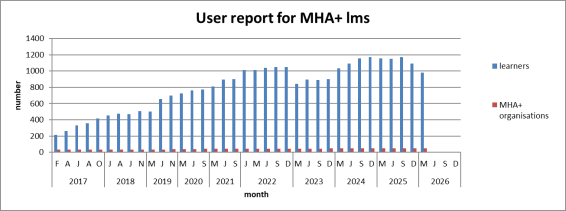
Chart showing LMS registered users as at March 2026
We monitor and evaluate the LMS, products, outputs and users
View the MHA+ LMS learning and development products accessed and completed by our learners, as at March 2026.
Evaluation
All learners complete a quantitative evaluation of their skills, knowledge and confidence before and after learning events, and provide qualitative feedback on their learning experience afterwards.
View the pre and post evaluation of knowledge, skills and confidence (KSC), as at March 2026.
Other evaluation information we gather gives us evidence and perspectives that we use to refine our content and inform what learning and development we commission.
Commissioning and savings
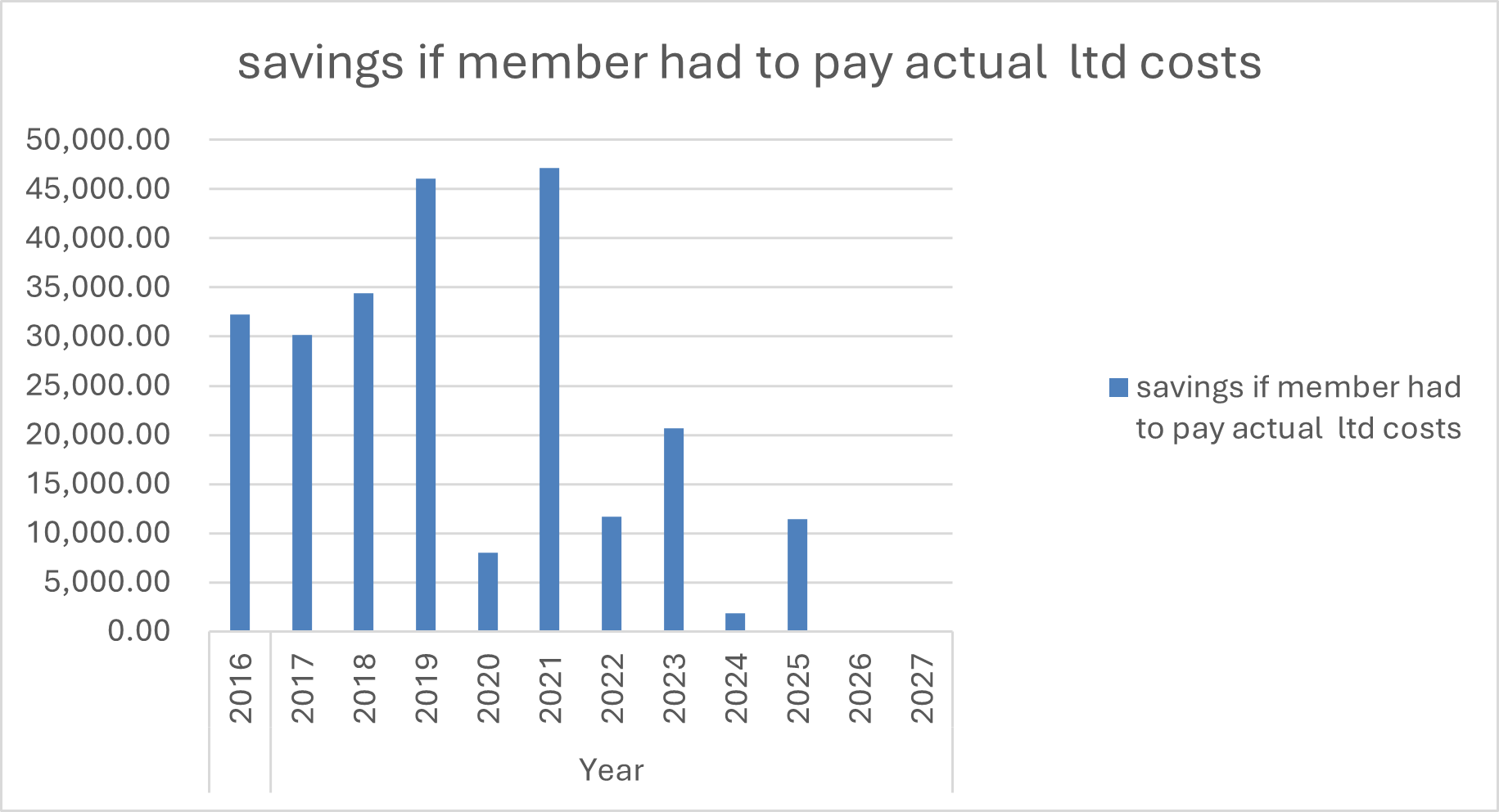
MHA+ provides a range of workforce development products to members free of charge. We measure the savings achieved through our commissioning of this learning and development content.
View the MHA+ commissioned ”products” savings to date, as at March 2026.
Skills development
Our skills and workforce development offer aims to provide learning, training and development opportunities that meet the Gold Standard. This means we aim to:
- help deliver improved economic, social and environmental outcomes
- maximise evidence of social value, by converting social value targets into agreed outcomes with clear timescales
- develop the MHA+ portfolio and our priorities in relation to building social capital
- provide learning, training and development opportunities that support MHA+ in delivering framework management systems that aid collaboration and dispute avoidance
- develop accessible, cross-disciplinary learning, in a range of formats that includes content from our supply chain and subject matter experts, so that suppliers’ contribution to learning and development continues to build a strong body of shared knowledge
These aims are set out in Constructing the Gold Standard: creating a Gold Standard action plan (page 30), frameworks, SMEs and social value (page 36), effective framework contracting (page 69), and training and guidance on Gold Standard frameworks (page 92).
This supports getting projects and programmes right from the start, in line with the aspirations of the Construction Playbook.
Our skills and development infrastructure has been developed to:
- embed social value
- enhance training, skills and employment opportunities, including content to help deliver carbon reduction
- improve health and wellbeing
- support small and medium-sized enterprises (SMEs) through public procurement, by working collaboratively
- maximise evidence of social value, by converting social value targets into agreed outcomes with clear timescales
- make sure individuals have the knowledge and training they need to carry out their responsibilities for a project or programme
- achieve successful delivery, by developing functional expertise
- help MHA+ members build a sustainable, resilient and effective relationship with our framework providers
- develop accessible, cross-disciplinary learning, in a range of formats that includes content from our supply chain and subject matter experts, so that suppliers’ contribution to learning and development continues to build a strong body of shared knowledge
- adopt digital, automated processes
- invest in skills, people and innovation
These aims are set out in the Construction Playbook: outcome-based approaches (page 30), cross-cutting priorities (pages 5 and 6), early engagement and specifications, and benchmarking and evaluating bids (pages 26 and 28), successful relationships (page 70), people and governance (page 34), effective contracting (page 44), pipelines, portfolios and longer-term contracting (page 16), and organisational management (page 82).